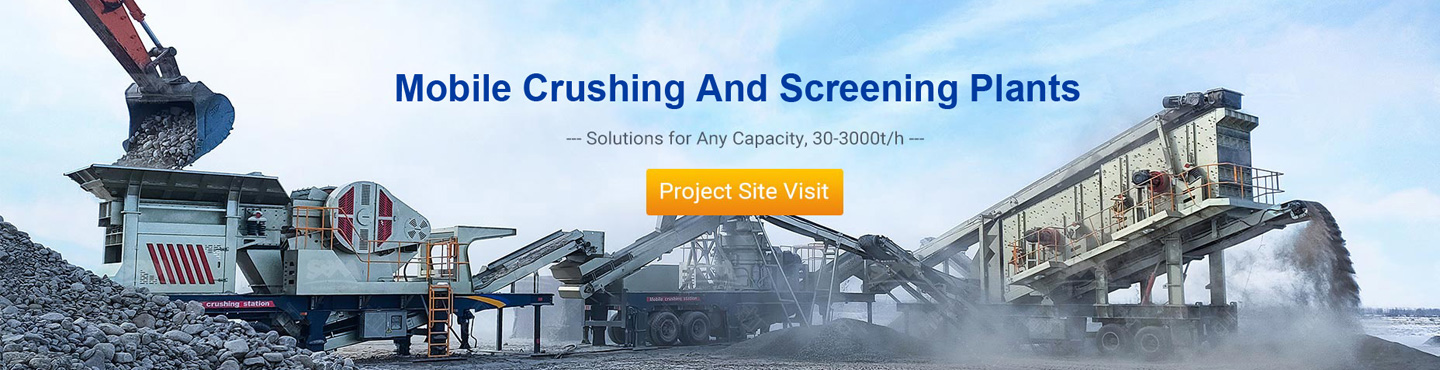
Convenience and Flexibility of Mobile Crushers: Driving Instant Uptime and High-Yield ROI
In modern aggregate processing and mining operations, traditional infrastructure timelines represent a massive bottleneck. Waiting weeks or months for site preparation, concrete foundation pouring, and complex auxiliary alignment destroys operational momentum. The modern answer to this challenge lies in the convenience and flexibility of mobile crushers—engineered tracking or wheeled systems designed to transform raw material into high-value aggregate within hours of arrival. By deploying fully integrated, highly agile crushing platforms, operators eliminate infrastructure waste, optimize internal quarry logistics, and capture market demand with unprecedented speed.
Zero-Concrete Foundation: The Key to Immediate Site Commissioning
The primary economic and operational differentiator of modern wheel-mounted or tracked mobile units is the complete elimination of static civil engineering requirements. Stationary plants demand extensive engineering surveys, deep excavation, and steel-reinforced concrete footings to handle the severe dynamic loads generated during heavy primary reduction.
Modern mobile crushing stations leverage heavy-duty, stress-relieved structural chassis engineered with calculated load distribution geometry. These systems safely absorb internal kinetic forces and harmonic vibrations through integrated hydraulic support legs and stabilized structural frameworks. The result is a zero-concrete foundation design that allows immediate site commissioning on any level, compacted ground. By removing civil construction from the critical path, project managers can save up to 30-40% in initial site setup expenditures and compress the deployment schedule from months down to a single shift.
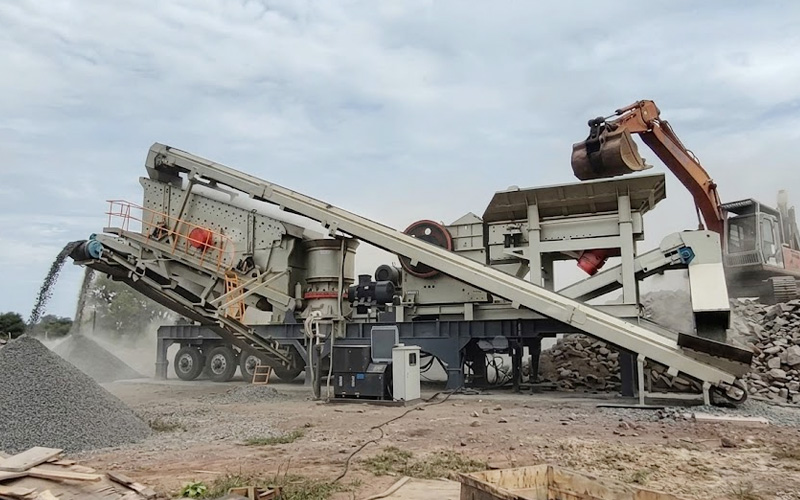
Seamless Intra-Quarry Logistics and Integrated Processing Loop
As extraction faces advance in large-scale quarrying or mining zones, haul distances for rigid dump trucks scale exponentially, driving up fuel consumption, tire wear, and fleet maintenance overhead. Mobile crushing configurations solve this structural cost by bringing the processing plant directly to the muck pile.
The operational agility of these systems allows for rapid transition between different quarrying sectors, keeping haul cycles minimal and highly efficient. This convenience is driven by a fully self-contained design philosophy where all essential processing systems are integrated onto a single chassis:
- Heavy-Duty Feeders: Provide a regulated, high-volume flow of run-of-mine material into the crushing chamber without requiring separate hoppers.
- High-Performance Onboard Screens: Execute precise sizing and material segregation immediately after reduction, ensuring exact product grading without standalone screening plants.
- Integrated Conveyor Matrices: Return oversized material or stack finished aggregate via onboard discharge units, completely eliminating the labor and setup complexity of auxiliary site conveyors.
Mathematical Verification: High Capacity Matched with Agile Parameters
Flexibility does not mean a compromise in structural power or throughput velocity. By analyzing actual technical configurations from the Liming product fleet, the massive processing capacities achievable via mobile platforms become mathematically evident.
| Mobile Station Model | Primary Integration Component | Maximum Feed Size (mm) | Throughput Capacity (t/h) | Power Rating (kW) | Operational Weight (T) |
|---|---|---|---|---|---|
| NK75J Primary Mobile Station | PE3040 Jaw Crusher & FK0936 Vibrating Feeder | 680 mm | 150 – 350 t/h | 141.4 kW | 39 T |
| NK300H Secondary Mobile Station | HPT300 Cone Crusher & SKX1536 Vibrating Screen | 220 mm | 110 – 440 t/h | 323.5 kW | 42 T |
For primary reduction stages, the NK75J Primary Mobile Station delivers aggressive mechanical crushing capability. Powered by a 141.4 kW power grid, the onboard PE3040 Jaw Crusher accepts raw boulder sizes up to 680 mm, processing them at a rate of up to 350 metric tons per hour. This massive throughput capability functions out-of-the-box, supported by an integrated 6m³ hopper volume and an FK0936 vibrating feeder that maintains optimal choke-fed conditions within the jaw chamber.
When transitioning to secondary sizing and fine-crushing applications, the NK300H Secondary Mobile Station (Screening with return material) demonstrates true closed-circuit flexibility. Utilizing a high-efficiency HPT300 Hydraulic Cone Crusher alongside an onboard SKX1536 vibrating screen, this 42-ton powerhouse handles up to 440 t/h of material. Oversized rocks are instantly screened and fed back into the cone chamber by the onboard return circuit, producing precise, highly cubical aggregate sizes in a singular, highly mobile footprint.
Maximizing TCO and Equipment Residual Value
The convenience and flexibility of mobile crushers radically optimize Total Cost of Ownership (TCO) and long-term asset valuation. When a stationary project concludes, the concrete foundations are abandoned as dead capital, and the labor costs associated with dismantling and transporting welded stationary equipment are high.
Conversely, mobile assets retain high liquidity and residual market value. Once excavation goals are met, the entire NK platform can be moved to a new site or resold on the secondary market with near-zero asset destruction. By converting fixed civil infrastructure expenses into variable, highly adaptable equipment assets, mining companies protect liquidity, mitigate project risk, and achieve rapid ROI validation.